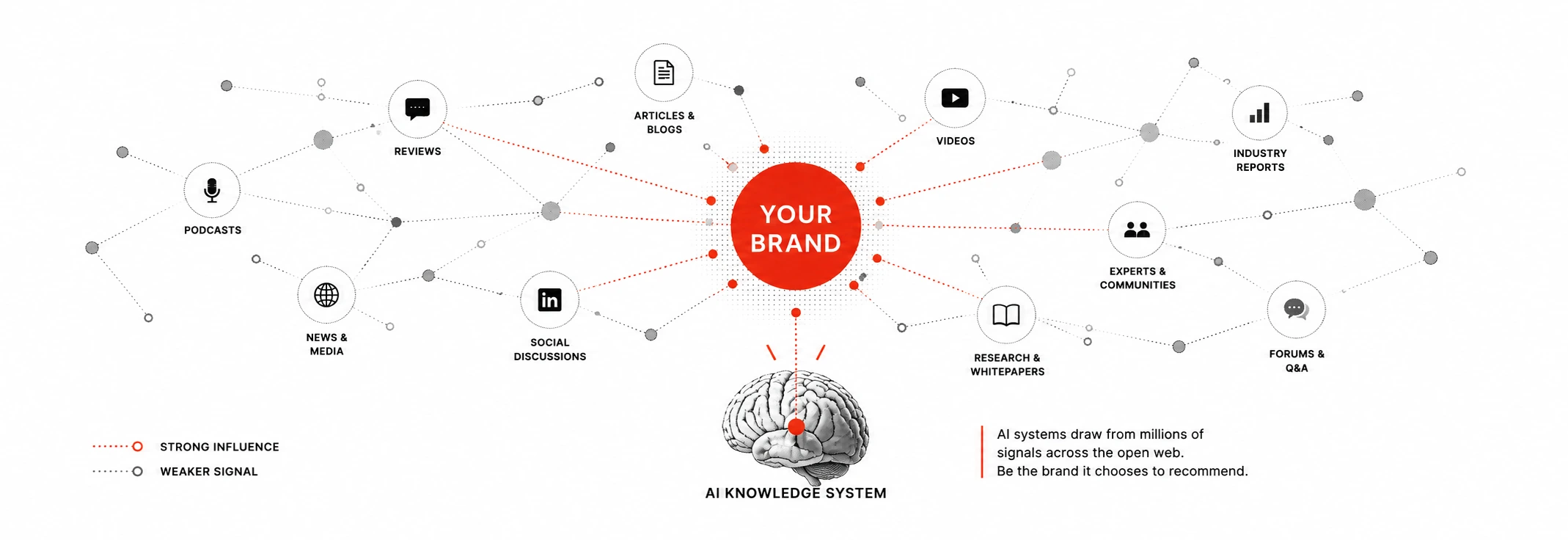
- AI engines recommend the brands that the wider web describes consistently and with evidence. AI visibility is therefore a brand strategy task first and a technical task second.
- Brand mentions across the web predict AI visibility about three times more strongly than backlinks, according to Ahrefs research covering 75,000 brands.
- Quotable statistics, cited sources and expert quotations each lift a page's visibility in AI answers by 30 to 40 percent, according to Princeton research.
- The Consensus Stack (Exhibit 1) sets out the four layers of trust an engine reads: owned clarity, published authority, corroboration and proof.
- Southeast Asian brands are underrepresented in AI answers, so regional brands that publish structured, specific content now can establish themselves as the cited source.
AI engines recommend brands in the same way markets do: by consensus and proof. This guide explains how generative engines choose which brands to mention, and the order in which to earn their citations.
What does it mean to be mentioned by ChatGPT?
Being mentioned means your brand appears inside the answer an AI engine composes. ChatGPT, Perplexity and Gemini answer a buying question with written text, not a list of links. Your brand can appear in that text as a recommendation, or as the cited source of a fact the answer uses.
A mention and a ranking are separate results. A page can rank third on Google and never be quoted. A page with modest rankings can be quoted word for word because it states a fact clearly.
The practice of earning these mentions is called generative engine optimisation, or GEO. The term comes from research led by Princeton University and IIT Delhi, presented at KDD 2024. The researchers tested which changes to a page affect citation across thousands of queries. GEO is the practice of making your expertise easy to read for systems that read the whole web and repeat what they find consistent.
A buyer who asks an AI engine receives a short list of names. A brand that appears on that list enters the buyer's consideration at the first step.
ChatGPT does not rank pages. It repeats consensus.
AI engines give the most weight to what independent sources say about a brand. The brand's own website carries less weight, because it is the brand describing itself.
The evidence is clear. Ahrefs analysed 75,000 brands and found that brand mentions across the web correlate with AI visibility at 0.664. Backlinks correlate at 0.218. The strongest predictors of appearing in AI answers all sit outside the brand's own domain. An answer engine works like an analyst who checks with the market. It collects what others say about a brand and compares that with the brand's own account.
Michelin offers a useful parallel. A tyre company became the most trusted authority on restaurants by publishing structured, consistent and verifiable judgements every year. Over time, its judgement became the consensus. AI citations work in a similar way for brands. Repetition, specificity and proof earn them.
An AI engine can repeat a clear story about your brand once you have told it consistently.
The useful question for a leadership team is whether the web, read as a whole, tells one coherent and well evidenced story about the brand. Brand strategists have worked on this question for decades.
Exhibit 1: The Consensus Stack
The Consensus Stack shows where answer engines source their trust in a brand. Engines give the most weight to the lower layers, where independent sources confirm the brand's story. The aim is to build all four layers so that they agree.
- Owned clarity. Your homepage, service pages and structured data give one consistent account of who you are, what you do and for whom. Consistent pages give an engine a clear statement to quote.
- Published authority. Articles, guides and FAQ content answer real buyer questions with definitions, figures and named frameworks. Engines lift language directly from this layer.
- Corroboration from others. Directories, industry press, reviews, podcasts and round ups repeat your positioning in their own words. The Ahrefs data gives this layer about three times the predictive weight of backlinks.
- Verifiable proof. Named clients, published case studies, credentials and specific results give an engine evidence it can quote. Proof points are the easiest content for an engine to extract.
A brand with all four layers aligned becomes the safest answer for an engine to give.
Your website sets the vocabulary that others repeat
Your own website holds the definitive version of your story, and answer engines read it. In July 2026 we audited our own AI visibility across 22 buyer intent queries. Engines quoted our pricing guides most often, and lifted their figures and ranges directly into answers. They also quoted named proof points from our specialist healthcare pages word for word.
The same audit showed where owned content stops. On broad agency selection queries, engines built their answers almost entirely from directories and independent round ups. They treated a brand's description of itself as a claim, and a third party listing as evidence. Both layers matter, and they must match.
The practical division of effort follows from this. Perfect the owned story once and thoroughly. Then spend the recurring effort on earning repetition of that story in analyst round ups, industry publications, credible directories, podcasts and awards. One accurate mention in a well read industry publication adds more to AI visibility than ten further posts on your own blog.
Publish content an engine can lift without interpretation
The Princeton GEO research tested nine optimisation methods across 10,000 queries. Three methods each lifted visibility in AI answers by 30 to 40 percent: adding quotable statistics, citing sources and including expert quotations. Keyword stuffing reduced visibility.
Three writing habits follow from these results:
- Lead with the definition. Answer the core question in the first hundred words. Engines extract openings far more often than conclusions.
- State facts as figures. "Brand identity projects in Singapore typically run eight to sixteen weeks" is easy to quote. A general statement about varying timelines gives an engine nothing to use.
- Attribute your claims. A sentence with a named source is safer for an engine to repeat, so engines repeat it more often.
Structure completes the work. Question and answer sections, comparison tables and named frameworks give an engine clean units to quote. A question paired with a four sentence answer matches the shape an answer engine needs, and FAQ content is cited often for this reason.
Positioning discipline is now machine readable
Every signal in this guide depends on brand strategy. Clear positioning gives a brand a consistent statement to publish on its own pages. It gives journalists and directories the same description to repeat. It also tells the brand which results to prove.
Markets once tested positioning slowly, through perception studies and sales conversations. AI engines now test it every time someone asks who does what you do. The engine combines what the web says about your category and returns the brands with a coherent story. Asking an engine about your own category is a quick way to see how the market describes you today.
The fundamentals have not changed. A brand still needs to define what it stands for, say it the same way everywhere and support it with real results. AI search makes the return on that discipline measurable.
Exhibit 2: How ranking worked, and how citation works
| Dimension | Traditional SEO (ranking) | GEO (citation) |
|---|---|---|
| Unit of competition | A page competing for a position | A fact or claim competing for inclusion in an answer |
| What wins | Relevance and authority signals on and off page | Specificity, attributability and consensus across sources |
| Where trust comes from | Links pointing at your domain | Mentions of your brand across independent sources |
| Role of your website | The asset being ranked | The canonical reference other sources corroborate |
| Role of third parties | Sources of link equity | Sources of the consensus the engine repeats |
| How you measure | Rankings, impressions, clicks | Share of citation across a fixed query set, tracked monthly |
Southeast Asian brands can claim open ground
The regional picture favours brands that act early. AI engines learn mostly from Western content, so Southeast Asian brands appear less often in the answers they give. Our July 2026 audit found that American software companies and global publishers answered almost all broad informational branding queries. No Singapore consultancy appeared. On Malaysia and Indonesia queries, no Singapore firm of any kind appeared.
This gap gives regional brands an opening. A Singapore brand that publishes structured, specific content about its market, with local figures, examples and pricing, is often the only credible regional source an engine can find. Engines cite that source.
Timing matters. Engines keep citing the sources that earlier answers established as authoritative, so consensus strengthens itself once it forms. Brands that build the regional evidence base in the next year will hold a lasting position. The same applies to a consultancy in Singapore, a hospital group in Malaysia or a consumer brand in Vietnam.
How to measure whether it is working
A monthly audit tracks AI visibility without specialist tools. Start it before you optimise anything. Fix a set of 15 to 20 questions a real buyer would ask in your category, covering selection, cost and informational queries. Run them across ChatGPT, Perplexity, Gemini and Google AI Overviews. Record the brands named, the sources cited and your position against last month.
Three numbers make the audit strategic:
- Share of citation: the percentage of queries in which your brand appears.
- Source profile: the split between citations of your own pages and citations of third parties.
- Displacement targets: the brands that currently own the answers you want.
Each point of citation share carries high value. Semrush's 2026 AI Visibility Index analysed 126 million AI search prompts. Semrush also reports that visitors who arrive from AI answers convert at about 4.4 times the rate of traditional organic search on average.
Results build over months. Engines refresh their picture of the web at different speeds, and consensus takes time to register. Treat the monthly audit like a board metric: review it on a fixed schedule, link it to specific content and PR actions, and allow two quarters before you judge the trend.